Lambda-Cyhalothrin vs Bifenthrin Technical Material: 2026 Buyer's Comparison
TL;DR — Side-by-side comparison of lambda-cyhalothrin and bifenthrin TC — efficacy, residual, formulation fit, price basis and where each pyrethroid wins in 2026.
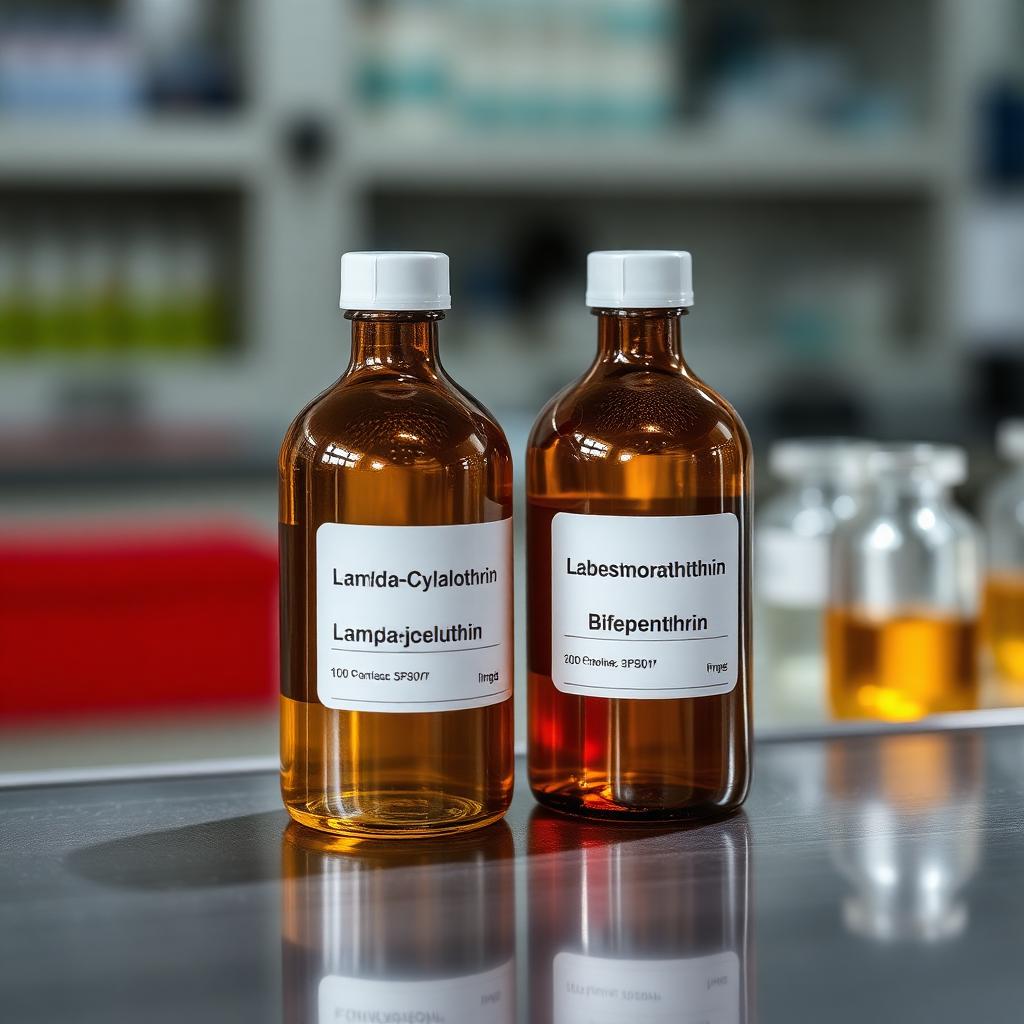
Lambda-cyhalothrin and bifenthrin are the two pyrethroids that show up on almost every formulator's 2026 sourcing list. They look interchangeable on a price sheet — both are Type II synthetic pyrethroids, both target broad-spectrum chewing and sucking insects, both move primarily as 95–97% TC out of China — yet they behave very differently in the field, in the formulation tank, and at customs. This is a buyer-side comparison written for distributors and formulators deciding how to split allocation between the two for the 2026–2027 season.
Mode of action and target spectrum. Both molecules act on the voltage-gated sodium channel (IRAC Group 3A), producing the rapid knock-down that defines the pyrethroid class. The practical differences sit in spectrum and persistence. Lambda-cyhalothrin is the more aggressive contact-and-stomach insecticide on Lepidoptera (Helicoverpa, Spodoptera), thrips, and adult whitefly. Bifenthrin holds an edge on mites, ants, termites, and soil-dwelling pests, with meaningfully longer residual on inert surfaces and in soil — which is exactly why it dominates structural pest control and turf markets.
Residual and formulation behaviour. Lambda-cyhalothrin's faster degradation profile is an advantage on edible crops where PHI matters; bifenthrin's longer residual is the reason it keeps showing up in non-crop and pre-plant uses. In the tank, lambda-cyhalothrin formulates cleanly as EC at 2.5% and 5%, as CS (microencapsulated) for extended residual on cotton and public health, and as ZC mixtures with neonicotinoids. Bifenthrin is more commonly seen as 10% EC, 25% EC, and 100 g/L SC — and its higher log P translates to lower water solubility, which the formulator must respect when choosing surfactants.
MRL and regulatory posture. Both pyrethroids carry full EU and Codex MRLs across major crops, but the per-crop ceilings differ — lambda-cyhalothrin generally has higher cotton, cereal and brassica tolerances, bifenthrin has tighter limits on leafy crops in the EU. For Turkish exporters working under B-Reçete, the safe move is to map intended target crop against the destination market's MRL table before committing to a TC; a switch made for a small price advantage can trigger a residue failure that costs ten times the saving.
2026 price basis. Q2 2026 ex-China FOB pricing put lambda-cyhalothrin 97% TC at roughly USD 18.5–20.5/kg and bifenthrin 97% TC at a 25–35% premium reflecting tighter capacity and structural pest-control demand. The June 2026 China pesticide ban removed several legacy organophosphate alternatives, which is structurally supportive of both molecules for the next 12–18 months. Buyers locking 6–12 months of cover at the current basis are positioning ahead of the demand pull that historically follows an OP phase-out.
How to split allocation. For a Turkish or MENA distributor with a balanced row-crop and horticulture book, a 60/40 lambda-cyhalothrin to bifenthrin TC split typically covers the portfolio: lambda for cotton, maize, cereal and vegetable Lepidoptera, bifenthrin for mites, soil pests and structural uses. Public-health tenders almost always specify lambda CS. Where a buyer is heavily exposed to turf, structural, or stored-product markets, the bifenthrin share rises sharply.
Impurity profile and 5-batch analysis. The gap between a first-tier Chinese manufacturer and a grey-market repacker rarely shows up on the certificate of analysis for the active alone — it shows up in the impurity fingerprint. For lambda-cyhalothrin, the critical parameters are the cis/trans isomer ratio and the residual solvent profile from the pyrethroid synthesis; for bifenthrin, the (1R,3R)-cis:(1S,3S)-cis enantiomer ratio and biphenyl residuals dominate the impurity discussion. A proper 5-batch analysis — mandatory for EU and Turkish registration under B-Reçete — surfaces these variables across production lots and gives the registrant the statistical basis to defend the technical specification at renewal. Buyers who accept a single batch analysis to save a few weeks in the qualification cycle almost always pay for it later, either at MRL testing or at the next registration renewal.
Packaging, transit and Turkish customs practice. Both TCs ship in 25 kg fibre drums with polyethylene liners; lambda-cyhalothrin's melting point (49.2 °C) and bifenthrin's (68–70 °C) mean summer transit through the Red Sea or Suez without temperature control can cause sintering, which is a cosmetic issue but slows down downstream milling. CIF Mersin and CIF İzmir are the practical delivery bases for Turkish formulators; buyers requesting DDP with Turkish customs clearance should factor in the Zirai Mücadele İlaçları İthalat İzin Belgesi timeline, which for a first-time SKU sits at 6–10 weeks after full dossier submission. Pre-clearing the registration through WECON's Turkish counterpart avoids the classic first-shipment demurrage bill.
Registration and formulation partner pairing. Neither molecule is worth much as a bulk TC without a downstream formulation and registration path. WECON's typical Turkish and MENA customers move lambda-cyhalothrin as 2.5% EC and 5% EC for retail packs, 100 g/L CS for cotton and public-health tenders, and 106 g/L ZC in combination with thiamethoxam or chlorantraniliprole for premium horticulture. Bifenthrin moves as 100 g/L EC for row crops, 25 g/L SC for turf, and 100 g/L EC + imidacloprid for termite pre-construction. Matching TC purity to the intended formulation avoids the classic mistake of over-specifying an expensive high-purity lot for a low-load EC where a 95% TC would meet spec at a materially better basis.
Related reading. For the wider pyrethroid price picture, see our July 2026 pyrethroid price update; for the neonicotinoid decision, see our imidacloprid vs acetamiprid buyer's comparison; and for the broader agrochemical sourcing landscape, see our 2026 agrochemical supplier guide.
Want a side-by-side quote on lambda-cyhalothrin and bifenthrin TC, with five-batch analysis and CIF basis for your nearest port? Share your molecule list and target volumes — WECON will return a comparison sheet within 24 hours, sourced directly from Yangnong and partner plants.