Biopesticides vs Conventional Pesticides: Building a Modern IPM Programme
TL;DR — Biopesticides are growing at ~15% CAGR but conventional chemistry still moves ~95% of the volume. Here is how serious buyers combine both inside a 2026 IPM programme — and how to source each class.
In this article
"Biopesticides vs conventional pesticides" is one of the most misleading framings in modern crop protection. The two classes are not competitors in most real programmes — they are complementary tools that solve different parts of the same problem. Biopesticides are the fastest-growing segment in the market (roughly 15% CAGR through the second half of this decade against ~3% for the total ag-chem market), but conventional chemistry still accounts for about 95% of applied volume and virtually all of the curative knockdown work. Any serious 2026 IPM programme uses both, deliberately, and any serious sourcing strategy has to be built around both. This guide walks through the head-to-head comparison, where each class actually wins, a four-step IPM framework you can implement this season, and the sourcing and compliance implications a distributor or formulator needs to plan for.
Why the "vs" framing is misleading
The "biopesticides will replace conventional pesticides" narrative is a fundraising deck, not a field reality. Biopesticides — microbial actives (Bacillus thuringiensis, Beauveria bassiana, Trichoderma spp.), botanicals (azadirachtin, pyrethrum), biochemicals (pheromones, plant extracts), and RNAi products — win on residue profile, pollinator safety, resistance management and organic-certified markets. Conventional synthetic chemistry — pyrethroids, neonicotinoids, triazoles, sulfonylureas, glyphosate — wins on curative speed, cost per hectare, storage stability and reliability under stress. In every real cropping system we support, both classes appear on the same annual plan, routed to the pest, growth stage and market channel where each is strongest.
Head-to-head: biopesticides vs conventional pesticides
The comparison below is deliberately simplified — individual actives vary — but it captures the pattern almost every buyer sees on their own farms and in their own margins.
Mode of action. Biopesticides typically act through narrow, target-specific pathways: Bt Cry toxins bind to specific lepidopteran gut receptors, Beauveria infects insect cuticle, azadirachtin disrupts moulting. Conventional chemistry usually acts on broad-spectrum receptor systems: pyrethroids on sodium channels (IRAC 3A), neonicotinoids on nicotinic acetylcholine receptors (IRAC 4A), triazoles on ergosterol biosynthesis (FRAC 3).
Speed of kill. Conventional wins decisively. A pyrethroid drops susceptible lepidoptera in hours; Bt takes 24–72 hours of larval feeding before mortality; Beauveria needs 3–7 days of humid conditions. When you're in front of an outbreak, speed matters.
Residue and MRL. Biopesticides win decisively. Most microbials and many botanicals qualify for zero or very low MRLs and short pre-harvest intervals, which is why they dominate pre-harvest windows and export-quality tender crops.
Resistance risk. Both classes carry resistance risk, but conventional chemistry is where the documented crises live (Q-biotype whitefly on neonicotinoids, diamondback moth on pyrethroids, ryegrass on ALS herbicides). Biopesticides with multi-site or complex modes of action are lower-risk resistance partners in a rotation.
Cost per hectare. Conventional wins by a wide margin on most row crops. Biopesticides often cost 2–5× per hectare per application, and typically need more applications per season.
Shelf life and storage. Conventional TC and formulations tolerate warehouse conditions across MENA and South Asia for 2+ years. Live microbial products need cool-chain (often refrigerated), have 6–18 month shelf lives, and lose potency in hot storage. This is a real logistics constraint, not a footnote.
Registration timeline. Biopesticides register faster in most jurisdictions (reduced data requirements for microbials of known safety), often 12–24 months vs 36–60 months for a new synthetic. Registration cost is proportionally lower. This is why the biopesticide pipeline is so active.
Where each class wins in the field
Biopesticides are the right tool for: greenhouse vegetables in the last three weeks before harvest; organic and residue-sensitive export programmes (leafy greens, berries, herbs, table grapes); pollinator-critical periods (bloom on almond, apple, oilseed rape); early-instar lepidopteran pressure where a 48-hour kill curve is acceptable; and as rotation partners to break resistance in high-pressure systems (Bt or spinosad rotated against pyrethroid-heavy programmes).
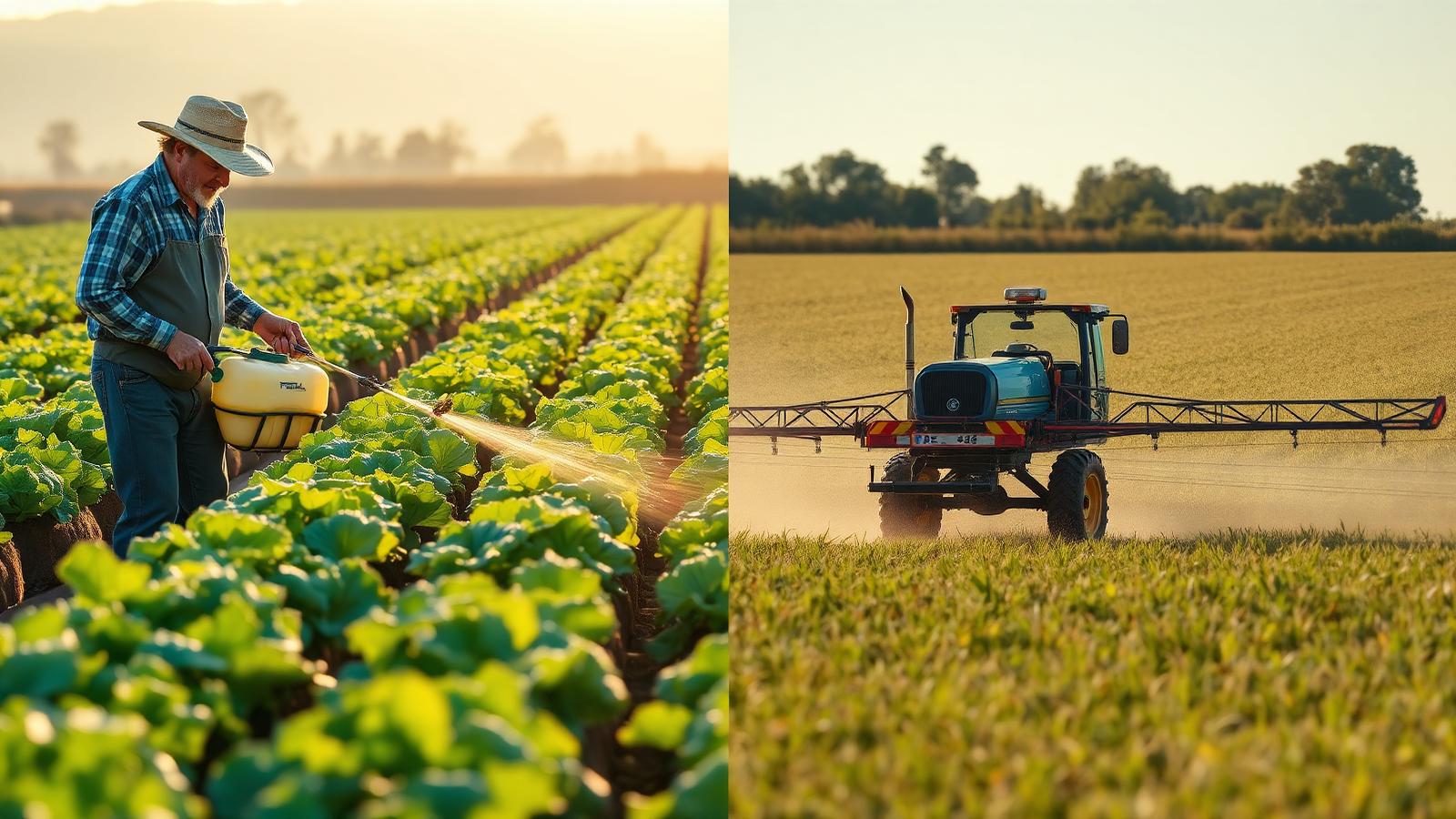
Conventional chemistry is the right tool for: curative knockdown when the field is already under threshold; broad-acre row crops where cost-per-hectare drives the decision (cotton, wheat, maize, soy); pre-emergent and residual weed control on herbicide-tolerant systems (see our glyphosate TC catalogue); seed treatment and soil applications where microbial products struggle with delivery; and any programme where storage temperatures routinely exceed 35°C and cool-chain isn't realistic.
A four-step IPM programme that uses both
IPM is not "use less pesticide." IPM is "use the right tool at the right threshold, and rotate deliberately." The framework below is what our agronomy partners deploy across Turkey, Egypt and Pakistan on tender crops and row crops alike.
Step 1 — Monitor. Weekly scouting on a defined transect, threshold-based decisions (not calendar spraying), pheromone traps for key lepidoptera, and — where budget allows — a simple digital record so year-on-year pressure is visible. This is the step most programmes skip and the step that unlocks every other saving downstream.
Step 2 — Prevent. Resistant varieties where available, crop rotation to break pest cycles, sanitation of crop residues, beneficial-insect habitat strips around the field, and biological seed treatments (Trichoderma, Bacillus subtilis) as the baseline. Prevention is where biopesticides quietly do most of their economic work — they don't show up as a "win" because nothing bad happened.
Step 3 — Rotate. Every application should advance an IRAC (insecticide) or FRAC (fungicide) or HRAC (herbicide) group rotation. A 2026-appropriate insecticide rotation on cotton or vegetables might look like: IRAC 3A (lambda-cyhalothrin) → IRAC 4A (acetamiprid or imidacloprid) → IRAC 11 (Bt kurstaki) → IRAC 6 (abamectin) → IRAC 5 (spinosad, biological). Every distributor should be able to draw their programme on a whiteboard as a rotation, not a list.
Step 4 — Curative. When monitoring shows the population has crossed threshold and prevention/rotation hasn't held, deploy fast-acting conventional chemistry at the labelled dose — not below (creates resistance) and not above (creates residue). This is where the emamectin benzoate, pyrethroid and neonicotinoid workhorses earn their place in the portfolio.
Sourcing implications for distributors
A biopesticide-plus-conventional portfolio needs a dual-class supplier strategy. The conventional side is well understood — Chinese TC from MEE-permitted tier-one plants, five-batch analysis, GLP tox packages, and the discipline we lay out in our 12-question supplier vetting checklist. The biopesticide side has additional criteria that are easy to underweight until the first shipment fails: verified viable-count / CFU per gram at time of manufacture and at end of shelf life; documented cool-chain from plant to port to warehouse; strain identity and non-GMO documentation for microbials; and a manufacturer willing to guarantee potency at destination, not just at dispatch. A supplier who can only credibly serve one class is not a partner for a modern IPM programme — start from our supplier hub for buyer criteria if you are rebuilding your panel.
Packaging and logistics diverge sharply between the two classes. Conventional TC ships in 25 kg fibre drums or IBCs, tolerates FCL sea freight through the tropics without special handling, and consolidates cleanly with other agrochemicals. Live microbial biopesticides often need reefer containers or air freight, temperature-logged shipping units, and dedicated warehouse space that isn't co-located with volatile solvents.
Compliance and documentation
Both classes require the full dossier discipline outlined in our pesticide registration process guide, but the specific documents differ. For conventional actives, expect: COA per batch, MSDS in the destination language aligned to KKDIK / MEWA / APC format, GLP acute + sub-chronic + chronic + developmental tox, ecotox on bees / earthworms / fish / algae, two-year residue trials on target crops, phytosanitary certificate, and DG-compliant packaging (UN packaging codes on the drum). For biopesticides, expect: strain deposit certificate at a recognised culture collection (ATCC, DSMZ, CBS), non-pathogenicity data on non-target organisms, viable count / CFU per gram at manufacture and at expiry, absence-of-contaminants certification, and — for exports into the EU-aligned markets — Annex II data on the microbial active. See our compliance checklist for the full document map.
When to request samples vs jump to a PO
For a new conventional TC or formulation, a 500 g – 1 kg sample for internal QC (assay, impurity screen, formulation trial) is reasonable and standard. For a serious registration project, expect to buy a 5-batch analytical package from the supplier for the regulatory dossier — this is a paid, formal request, not a free sample. For a live microbial biopesticide, samples are less useful because potency is time- and temperature-dependent; instead ask for a witnessed potency test at a third-party lab on the actual production batch you intend to import. For repeat SKUs from a supplier you already qualified, skip samples and go direct to PO — the audit discipline lives in the incoming-QC step, not in re-sampling every shipment.
WECON ships both classes: high-purity conventional TC and formulations from Yangnong Chemical and MEE-permitted tier-one Chinese plants (browse our insecticide catalogue and herbicide catalogue), and biopesticide TC / formulations from qualified microbial and botanical manufacturers with documented cool-chain and potency guarantees. Whether you are rebuilding a resistance-broken conventional rotation or adding a first-time biopesticide line to your portfolio, we can quote both sides of the programme against the same PO — start from our full portfolio hub.
Frequently asked questions
Can biopesticides fully replace conventional pesticides in a commercial programme?
No — not on broad-acre row crops in 2026, and not for curative knockdown once a population is above threshold. Biopesticides replace 20–40% of applications in a well-run IPM programme on tender crops (greenhouse vegetables, orchard pre-harvest, export leafy greens), and function as rotation partners on row crops. Full replacement is a niche organic play, not a mainstream commercial reality.
What is the real cost difference per hectare between biopesticides and conventional chemistry?
As a working rule of thumb, biopesticides cost 2–5× more per hectare per application and often need 1.5–2× as many applications per season, so total programme cost can be 3–8× higher. That premium is recovered on tender export crops through MRL-clean produce, pollinator-safe bloom windows, and access to residue-sensitive channels — not on cotton or wheat.
How do biopesticides fit into an IRAC or FRAC rotation?
Very well — that's one of their strongest use cases. Bt (IRAC 11), spinosad (IRAC 5), Beauveria (IRAC unclassified microbial), and Trichoderma (FRAC BM02) all offer modes of action that don't overlap with the pyrethroid / neonicotinoid / triazole workhorses. Slotting a biopesticide into every third or fourth application dramatically slows resistance development on the conventional partners.
What extra documentation should I ask a biopesticide supplier for?
Beyond the standard COA and MSDS: strain deposit certificate at a recognised culture collection (ATCC, DSMZ, CBS), viable count / CFU per gram at both time of manufacture and at end of shelf life, non-pathogenicity data on non-target organisms, absence-of-contaminants certification, and — critically — a written potency guarantee at destination temperature, not just at dispatch.
Does WECON supply both biopesticides and conventional TC on the same PO?
Yes. We can quote a full IPM programme against a single PO — high-purity conventional TC and formulations from MEE-permitted tier-one Chinese plants alongside biopesticide TC and formulations from qualified microbial and botanical manufacturers, with matched documentation, appropriate packaging, and cool-chain logistics for the live-microbial line where required.