Imidacloprid vs Acetamiprid: A Neonicotinoid Buyer's Comparison for 2026
TL;DR — Imidacloprid and acetamiprid are the two neonicotinoids that dominate sucking-pest control. Side-by-side comparison of spectrum, residual, MRL posture and 2026 price basis.
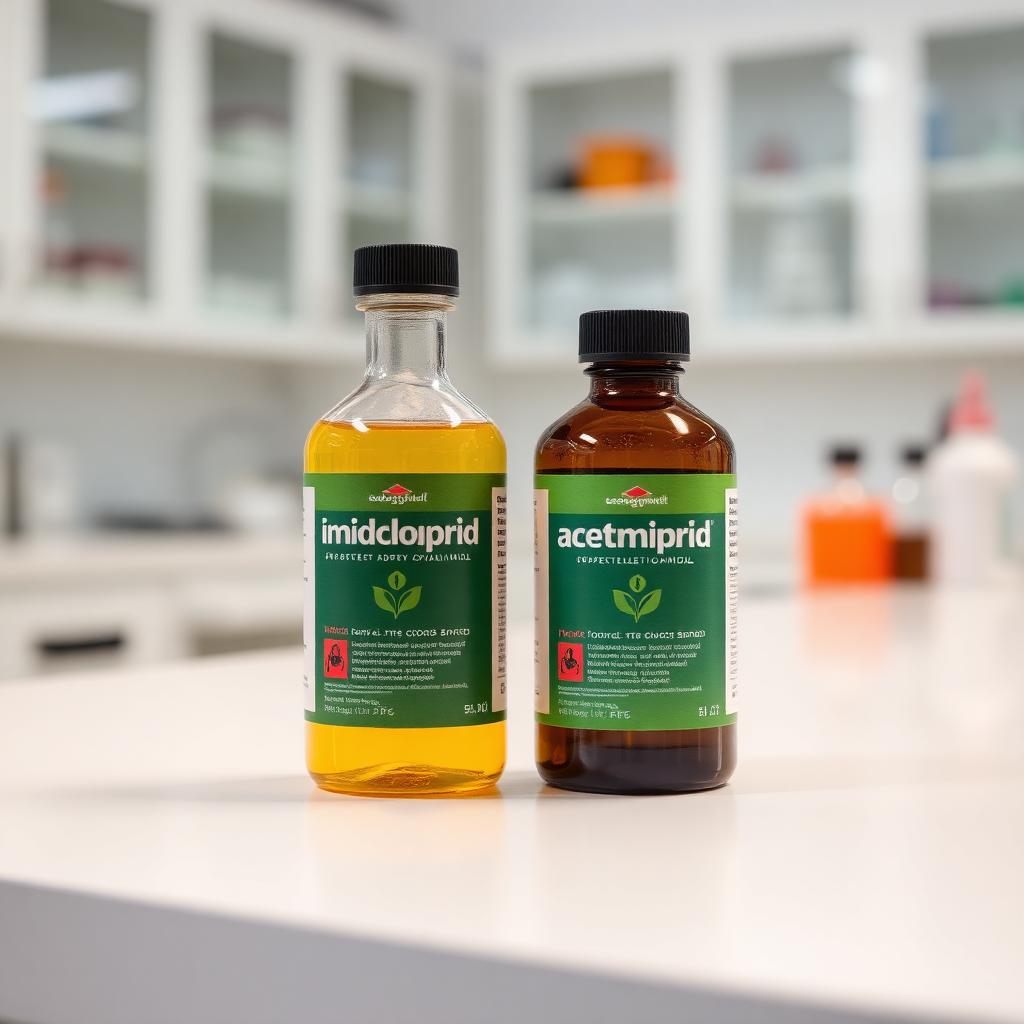
Imidacloprid and acetamiprid are the two neonicotinoids that anchor almost every 2026 sucking-pest portfolio across the Middle East, Turkey, North Africa and South Asia. They share a mode of action (nicotinic acetylcholine receptor agonists, IRAC Group 4A), they're both made at scale in China, and they often appear interchangeable on a price sheet — but their spectrum, residual, MRL posture and current price basis differ enough that picking the wrong one can quietly cost a distributor a full season of margin. This is a buyer-side comparison written for formulators and importers deciding allocation for the 2026–2027 season.
Spectrum and target pests. Both molecules target sucking pests — aphids, whiteflies, thrips, jassids, leafhoppers, scale — but the practical edges are different. Imidacloprid is the broader, more systemic option: outstanding on aphids and whiteflies in cotton, vegetables, and ornamentals, and the default choice for soil drench and seed treatment because of its strong xylem mobility. Acetamiprid sits in the same chemistry family but has a faster contact knock-down on adult whitefly and aphids, and a more favourable acute toxicity profile — which is exactly why it's the neonicotinoid that survives where imidacloprid faces re-evaluation pressure.
Residual, systemicity and application fit. Imidacloprid's higher water solubility and longer systemic residual make it the go-to for soil-applied and seed-treatment programmes; a single drench in vegetables can hold aphid and whitefly pressure for 4–6 weeks. Acetamiprid is more foliar-oriented, with faster initial knock-down but shorter systemic residual. Formulators typically position imidacloprid as 35% SC, 70% WG, 600 g/L FS (for seed treatment) and 350 g/L SC; acetamiprid is most common as 20% SP and 200 g/L SL for foliar spray.
Bee toxicity and regulatory posture. This is where the comparison really matters in 2026. Imidacloprid has been progressively restricted in the EU for outdoor use because of pollinator concerns, and several Middle East markets (Egypt, Saudi Arabia) have aligned their labels with EU restrictions for flowering-crop applications. Acetamiprid is the neonicotinoid that survived EU re-evaluation in 2018 and retains broader outdoor use authorisations — for any distributor whose end-customers export to the EU or Gulf cooperative markets, acetamiprid is the lower regulatory-risk pick.
MRL posture for export crops. Imidacloprid carries tighter EU MRLs on many leafy and pome crops (often 0.05–0.5 mg/kg) and is increasingly flagged in Turkish exports of stone fruit and cherries. Acetamiprid generally has more permissive Codex and EU MRLs on the same crops, which is why Turkish exporters of stone fruit, citrus and protected vegetables to the EU have been shifting their late-season sprays toward acetamiprid even at a price premium.
2026 price basis. Q2 2026 ex-China FOB pricing put imidacloprid 97% TC at roughly USD 11.5–13.0/kg, with capacity comfortable and inventories normal. Acetamiprid 97% TC traded at USD 21–24/kg — a structural premium of roughly 70–90% over imidacloprid, reflecting tighter manufacturing capacity, stronger EU-aligned demand, and the regulatory-risk premium described above. The gap has been steady through 2026 and is unlikely to compress while EU re-evaluations on imidacloprid remain open.
How to split allocation. For a Turkey or MENA distributor with a balanced book covering both protected vegetables and field crops, a 60/40 imidacloprid to acetamiprid TC split typically covers the portfolio: imidacloprid for soil drench, seed treatment, cotton aphid and broadacre sucking-pest control; acetamiprid for export-bound stone fruit, citrus, protected horticulture, and any label where bee-friendly positioning matters. Where a buyer is heavily exposed to EU-aligned export markets, the acetamiprid share rises sharply.
Want a side-by-side quote on imidacloprid and acetamiprid TC, with five-batch analysis and CIF basis for your nearest port? Share your molecule list and target volumes — WECON will return a comparison sheet within 24 hours, sourced directly from Yangnong and partner plants.