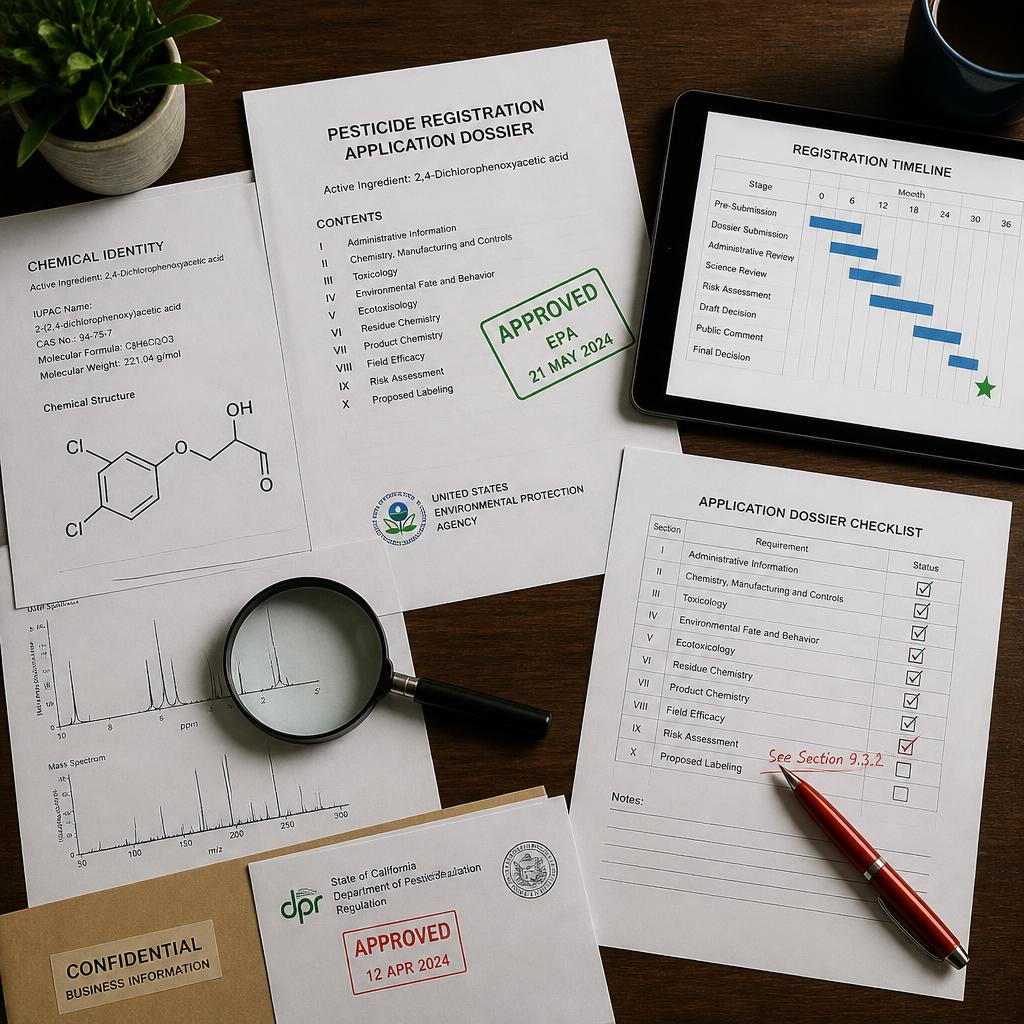
Importing Pesticide Technicals into Brazil: Registration, MAPA and the Paperwork That Decides the Shipment
TL;DR — Brazil is the largest pesticide market in the world and one of the hardest to enter. The rules run through three agencies and a new law — and most shipments that get stuck fail on the file, not on the product.
In this article
Brazil is the largest pesticide market in the world, and it is also one of the hardest to enter. The rules are clear once you know them, but they are spread across three agencies, a new law, and a filing system that changed in September 2025. Most shipments that get stuck do not fail on the product — they fail on the file. This guide walks through the registration and import paperwork for pesticide technical material, in the order a buyer actually meets it.
Three agencies, one file
Brazil runs a joint-evaluation system. MAPA, the Ministry of Agriculture and Livestock, assesses agronomic efficacy and issues the registration. ANVISA, the health surveillance agency, runs the toxicological and human-health assessment. IBAMA, the environmental institute, runs the environmental risk assessment. No product is registered without all three. The framework is Law 14,785/2023, published on 27 December 2023, which replaced the old Law 7,802/1989. One practical change matters most for exporters: since 15 September 2025, under MAPA Act 40/2025, new registration requests are filed only with MAPA through its SEI electronic system, and MAPA distributes the file to ANVISA and IBAMA. Filing directly with the other two agencies is no longer accepted.
Who can hold a registration
Only a company established and legally registered in Brazil can hold a pesticide registration. A foreign manufacturer cannot register in its own name. That means every technical-material shipment into Brazil runs through a Brazilian registrant — a local subsidiary, or a local partner acting as the official registrant. Before you quote, find out who that registrant is and whether they already hold the registration for your molecule. If they do, the question is equivalence: can your source be shown equivalent to the reference source already registered? If they do not, the question is a new technical product registration, which is a longer road. Either way, the registration names the manufacturing source, the specification and the impurity profile. A different plant means a different file. Registration data is confirmed item by item.
The equivalence route
For an active already registered in Brazil, the usual route for a new source is technical product equivalence. The applicant submits five-batch analysis data, the manufacturing process description, the impurity profile and the analytical methods, and the three agencies compare the new source against the reference. Expect questions on impurities first — that is where most equivalence files stall. A clean, complete five-batch package with consistent results moves faster than a thin file with gaps, and gaps are expensive: each round of questions adds months. Build the dossier with the equivalence test in mind from the start, not as an afterthought once the order is placed.
RET: the temporary route for trials
Law 14,785/2023 created the Special Temporary Registration, the RET, for new products intended for research and experimentation. If a Brazilian partner wants to run field trials with your material before committing to a full registration, the RET is the instrument. It is temporary and limited to the trial purpose, but it is often the fastest way to get material into the country legally and to generate the local efficacy data a full registration will need. Agree in advance who applies for it, who pays for the trials and who owns the data.
The import itself
Once the registration exists, the shipment still needs its own paperwork. The Brazilian importer files an import licence (LI) through Siscomex, Brazil's foreign-trade system, and the licence is tied to the registered product and the NCM customs code — pesticide technicals generally fall under heading 3808, and the exact subheading decides the duty rate. The invoice, packing list, certificate of analysis and the MSDS must match the registered specification and the licence, and the cargo is subject to MAPA inspection on arrival. A CoA that names a different batch or a different declared content from the registration is the most common reason a shipment sits at the port.
Timing: buy against the soybean calendar
Brazil's demand follows the soybean season. Planting runs roughly September to December, and formulation and distribution build up months before that. A technical order placed in the middle of the planting window is late; the formulation capacity and the port slots are already spoken for. The buyers who do best in Brazil plan the technical order against the registration timeline first — equivalence can take well over a year — and against the planting calendar second. If the registration is not in place, the shipment cannot move at any price. Our Brazil tariff update explains the duty proposal currently before Camex and what it means for formulated versus technical imports.
Brazil rewards patience and paperwork in equal measure. If you are lining up a shipment, send us the molecule, the Brazilian registrant and the registration status, and we will work through the equivalence, RET and timing questions with you — before the file, not after it.
Frequently asked questions
Which agencies register pesticides in Brazil?
Three: MAPA assesses agronomic efficacy and issues the registration, ANVISA assesses human-health risk, and IBAMA assesses environmental risk. No product is registered without all three.
Can a foreign manufacturer hold a Brazilian pesticide registration?
No. Only a company established and legally registered in Brazil can hold one. Foreign suppliers work through a Brazilian subsidiary or a local partner acting as registrant.
What is the equivalence route for a new technical source?
For an active already registered in Brazil, a new source proves equivalence to the reference source with five-batch analysis, the manufacturing process, the impurity profile and analytical methods. Impurity questions are where most files stall.
What is the RET in Brazil?
The Special Temporary Registration created by Law 14,785/2023 for new products intended for research and experimentation. It lets a partner run field trials and generate local efficacy data before a full registration.